Test engineers and developers use oscilloscopes to display, visualize graphs, and analyze electrical signals during research and development, verification, quality assurance, and troubleshooting or debugging of electronic systems, boards, and integrated circuits. Oscilloscopes play a key role in a variety of applications and technologies across all industries, including high-speed digital electronics, optical communications, radio frequency, power electronics, automotive and aerospace and defense.
Oscilloscopes are key test instruments for observing, analyzing, or recording the behavior of electrical signals. Some specific use cases for oscilloscopes in electronics labs include measuring voltage waveforms, analyzing electronic signals, detecting unwanted noise and crosstalk, and evaluating harmful transients in power systems.
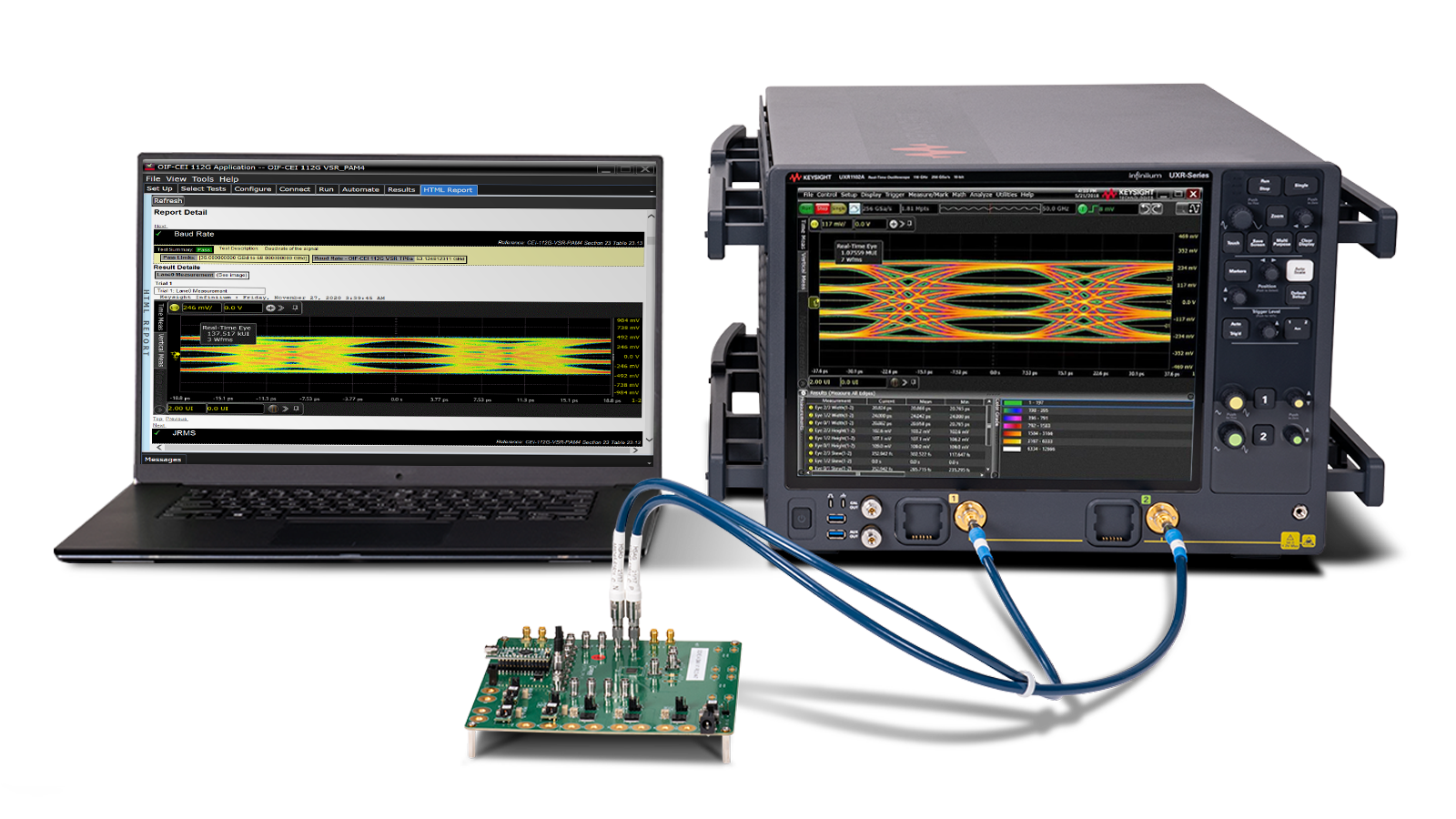
In high-speed signal analysis, oscilloscopes can measure signal integrity by displaying and measuring eye diagrams, including eye height and eye width. Mixed-signal oscilloscopes can help debug digital circuits by displaying the logic state and timing of measured digital signals. Advanced oscilloscopes can even help simulate ideal reference receivers for transmitter testing, measure fiber optic signals using optoelectronic converters, and analyze RF signals.
Because of their versatility, oscilloscopes have many different performance levels and software features depending on the application. They are indispensable tools in electronics development, troubleshooting and analysis.
Waveform sequencing lets you create multiple configured waveforms that contain multiple common segments. Sorting lets you build complex, long waveforms using as little instrument memory as possible. Waveform sequencing lets you save storage capacity by replaying shorter waveforms at different locations on the signal as needed. Many tests require long waveform memory records. The required record length...
This article describes its basic information and how it differs from an analog multimeter. ■ Summary The condition of an electronic device needs to be determined using a measuring instrument. For electronic devices whose condition cannot be determined visually, it is recommended that measurements be made with a digital multimeter. In this section, basic information about digital multimeters such as "What is a digital multimeter" and "Is there a difference between a digital multimeter and an analog multimeter" will be explained in detail...
Spectrum analyzers are primarily used to measure the amplitude of an input signal in relation to its frequency. A signal analyzer, on the other hand, measures both the amplitude and phase of an input signal at a single frequency. For more information, see the technical overview Spectrum Analyzers and Signal Analyzers. ,
Alternating current is suitable for transmission and distribution of electricity over long distances through the grid system. Direct current is a one-way flow of charge and is more reliable than alternating current, but is not suitable for long-distance transmission. Most electronic devices use DC because their voltage is constant, such as devices powered by batteries. Some devices also use rectifiers to convert AC to DC. Power supplies usually have an internal...
 Comprehensive test and measurement service provider-Shenzhen Weike Electronic Technology Co.


Hello!sign in